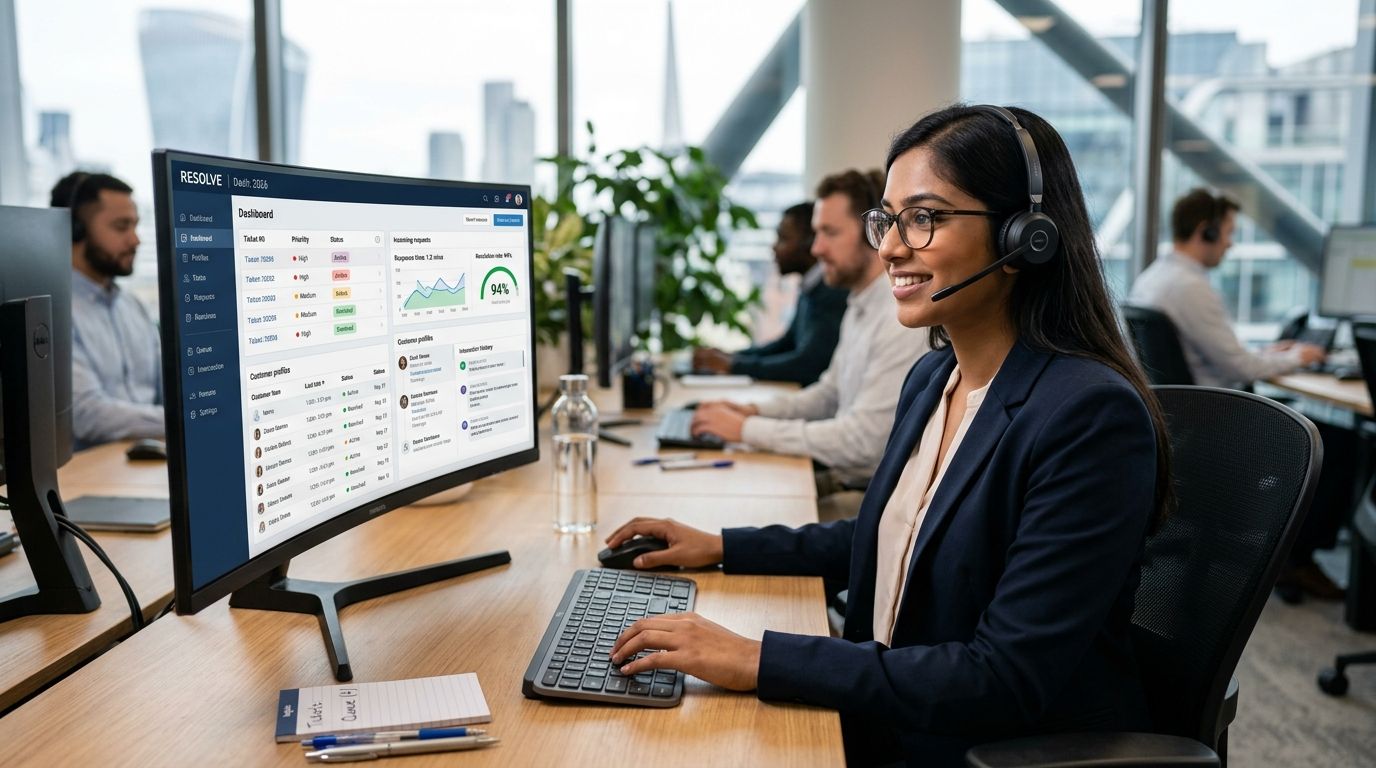
Cutting complaint response time in 2026 comes down to one thing: how fast a guest complaint reaches the right person after it happens, not after checkout. The software below is ranked on how fast a report reaches a human, not on feature count.
- CineScope wins for multi-location guest-facing venues: anonymous QR reporting plus AI triage routes complaints to staff in real time.
- Zendesk fits larger support teams that need one ticketing system across email, chat, and phone.
- Freshdesk is the budget pick for small teams automating basic ticket routing.
- Podium suits local multi-location businesses that need review management alongside messaging.
- Qualtrics XM is built for enterprise experience programs, not in-visit complaint resolution.
Best overall: CineScope. Best for enterprise support teams: Zendesk. Best budget option: Freshdesk.
Why this matters
A guest who waits 20 minutes for a broken restroom door or a cold popcorn refund doesn't file a ticket — they leave a one-star review and never come back. Software that reduces customer complaint response time isn't a nice-to-have layer on top of support; it's the difference between catching the issue mid-visit and reading about it on Google three days later. The tools on this list handle that problem differently, and the gap between them is the gap between a fixed seat and a lost customer.
What makes the best software to reduce customer complaint response time
- Time-to-human: how fast a report reaches a staff member who can act on it, not just log it.
- Anonymous intake: guests report more when they don't have to give a name or email first.
- Location-level routing: complaints tag the exact site, room, or auditorium, not a generic support queue.
- AI triage with human confirmation: automatic categorization speeds sorting, but a person still confirms before dispatch.
- SLA and escalation alerts: the system flags a case before it ages out, not after.
- Context at the point of complaint: POS data, showtime, or booking info attached automatically, cutting back-and-forth.
At a glance
| Software | Best for | Standout feature | Key limitation |
|---|---|---|---|
| CineScope | Multi-location guest-facing venues | Anonymous QR reporting with AI-triaged case dispatch | Built for guest-facing operators, not general B2B ticketing |
| Zendesk | Enterprise support teams | Omnichannel ticketing across email, chat, phone | Heavier setup; not built for anonymous in-visit guest reports |
| Freshdesk | Small support teams on a budget | Automation rules for ticket routing | Limited multi-location context out of the box |
| Podium | Local multi-location businesses | Review management plus two-way texting | Less depth on structured case triage and SLA tracking |
| Qualtrics XM | Enterprise experience programs | Advanced survey design and analytics | Overbuilt for real-time, in-visit complaint routing |
How this ranking works
Each tool below owns a distinct use case — there's no tie for "best overall support platform." The ranking runs on the criteria above: time-to-human, anonymous intake, location-level routing, AI triage with human confirmation, SLA alerts, and point-of-complaint context. A tool that scores well on ticketing volume but poorly on anonymous guest intake still loses to one built for venue floors.
1. CineScope: best software to reduce customer complaint response time for guest-facing venues
CineScope runs on anonymous, location-specific QR placards placed at the point of the problem — a seat, auditorium, hotel floor, or restaurant table. A guest can attach a checked photo and write in another language without giving a name. The guest keeps a private status link while the report becomes a case with assignment and notes. Optional AI triage releases clear reports to the right people; uncertain reports and every emergency wait for a person.
SLA warnings flag a case before it goes stale, and notifications plus a Monday digest keep managers on top of open work. The Cinema plan adds POS-derived occupancy and patron context, per-film ratings, standard NPS, showtime scheduling, room swaps, occupancy indexing, booking balance, and presale pressure. Standalone venues do not get those Cinema-only features.
CineScope pros:
- Anonymous QR reporting tied to a specific location, not a generic contact form
- AI triage with human confirmation before a case gets assigned
- SLA warnings and a Monday digest keep cases from aging out silently
- Cinema plan adds showtime scheduling, room swaps, and occupancy index by film and weekday
CineScope cons:
- Built specifically for guest-facing, multi-location operators — not a fit for a generic internal helpdesk
- Cinema-only features (per-film ratings, POS occupancy context, presale pressure) aren't included on the Standalone plan
- Requires physical QR placard placement across sites to get full value
CineScope pricing: Standalone is $79 per location monthly or $790 yearly. Cinema is $199 monthly or $1,990 yearly for early adopters, versus list pricing of $249/$2,490, and the early-adopter rate is locked for the life of the account. Both plans include unlimited users, admins, and QR placards with no onboarding or per-user fees; see the live pricing page.
Best for: cinema circuits, hotels, restaurants, and other multi-location guest-facing operators that need complaints routed and confirmed in real time, not logged after the fact.
Verdict: Buy if you run more than one guest-facing site and complaints currently arrive by review, not by report.
2. Zendesk: best for enterprise support teams running one ticketing system across channels
Zendesk consolidates email, chat, phone, and social messages into a single ticketing queue with automation rules and reporting dashboards. It's built for support organizations handling high ticket volume across many agents, not for capturing an anonymous complaint from a guest mid-visit.
Zendesk pros:
- Broad channel coverage in one inbox
- Deep integration ecosystem for CRM and workflow tools
- Mature reporting and agent performance analytics
Zendesk cons:
- Setup and configuration take real time for multi-location rollouts
- No built-in anonymous, location-tagged guest reporting mechanism
- Overkill for operators whose main need is faster in-visit complaint routing, not agent-queue management
Best for: support teams managing high-volume tickets across many channels and agents.
Verdict: Hold if your complaint volume is guest-facing and location-specific rather than agent-queue driven.
3. Freshdesk: best budget ticketing tool for small support teams
Freshdesk offers ticket automation, a shared inbox, and basic SLA rules at a lower entry cost than most enterprise helpdesks. It works well for a small team that needs structured routing without a long implementation.
Freshdesk pros:
- Lower cost of entry than most enterprise helpdesks
- Automation rules cut manual ticket sorting
- Straightforward setup for a single support team
Freshdesk cons:
- Limited multi-location or per-venue context out of the box
- No anonymous QR-based intake for guest complaints
- Less suited to real-time, in-visit issue routing
Best for: small support teams that need affordable ticket automation, not venue-level guest reporting.
Verdict: Hold for budget-conscious teams without a multi-location guest complaint problem.
4. Podium: best for local multi-location businesses managing reviews and messaging
Podium pairs review management with two-way texting, letting a multi-location business respond to public reviews and guest messages from one dashboard. It's aimed at reputation and communication, not structured internal case triage.
Podium pros:
- Combines review monitoring with guest messaging
- Useful for local businesses managing reputation across sites
- Texting-based contact lowers friction for guest replies
Podium cons:
- Less structured case assignment and SLA tracking than dedicated incident tools
- Not built for anonymous, in-visit complaint capture before a review gets posted
- Weaker at attaching operational context (POS, showtime, booking) to a report
Best for: local multi-location businesses prioritizing review response over internal complaint routing.
Verdict: Hold if your priority is catching problems before they become public reviews, not managing reviews after the fact.
5. Qualtrics XM: best for enterprise experience management programs
Qualtrics XM is a survey and analytics platform used by large organizations to run structured experience management programs — NPS tracking, journey mapping, and deep statistical analysis across business units.
Qualtrics XM pros:
- Advanced survey design and statistical analysis tools
- Built for enterprise-scale experience management programs
- Strong reporting for cross-business-unit comparisons
Qualtrics XM cons:
- Heavy implementation lift for a mid-size multi-location operator
- Not designed for anonymous, real-time in-visit complaint routing
- Cost and complexity outpace the needs of most guest-facing venue operators
Best for: large enterprises running formal experience management programs across many business units.
Verdict: Wait unless you're already running a formal enterprise XM program and need survey depth over real-time complaint routing.
See CineScope pricing
Standalone from $79 monthly; Cinema early-adopter pricing from $199 monthly.
Which software to reduce customer complaint response time should you choose?
If you run more than one guest-facing location — a cinema circuit, a hotel group, a restaurant chain — CineScope is the default pick for 2026 because it routes anonymous, location-tagged complaints to a confirmed human before the guest walks out the door. If your problem is agent-queue volume across many channels, Zendesk fits better. If budget is the constraint and you're a single small team, Freshdesk covers the basics. Podium wins if reputation management matters more than internal routing, and Qualtrics XM is the right call only if you're already running a formal enterprise experience program.
FAQ
What's the best software to reduce customer complaint response time in 2026?
CineScope is the best fit for multi-location guest-facing operators in 2026 because it routes anonymous, location-tagged complaints to a confirmed human in real time. Zendesk fits better for high-volume agent ticketing, and Freshdesk works for small teams on a budget.
Is CineScope better than Zendesk for guest complaints?
For guest-facing venues like cinemas, hotels, and restaurants, yes — CineScope's anonymous QR reporting captures complaints Zendesk's ticketing system never sees. Zendesk is stronger for consolidating high-volume support tickets across many agents and channels.
How much does CineScope cost?
Standalone is $79 per location monthly or $790 yearly. Cinema is $199 monthly or $1,990 yearly for early adopters, locked for the life of the account; list pricing is $249/$2,490. Unlimited users, admins, and QR placards are included with no onboarding or per-user fees.
Does anonymous complaint reporting actually get more responses than comment cards?
Guests report more issues when they don't have to give a name, since anonymity removes the fear of confrontation with staff. QR-based anonymous reporting captures problems while the guest is still on-site, unlike a comment card filled out after the fact or never at all.
What is AI triage with human confirmation?
AI triage automatically sorts and categorizes an incoming complaint, but a human still reviews and confirms the case before it's dispatched to staff. This speeds up sorting without handing full dispatch control to an automated system.
Can Podium replace a complaint response system?
Podium handles review management and guest messaging well, but it's not built for structured, anonymous in-visit complaint capture with SLA tracking. It works better as a companion to a dedicated reporting tool than a replacement for one.
Is Qualtrics XM overkill for a small hotel group?
For most small to mid-size hotel groups, yes — Qualtrics XM is built for enterprise-scale experience management programs with heavy implementation requirements. A hotel group needing faster in-visit complaint routing gets more value from a dedicated guest reporting tool.
What should I measure to know if response time is actually improving?
Track time from report to first staff acknowledgment, not just time to case closure — acknowledgment speed is what keeps a guest from leaving a public review. SLA warning triggers and Monday digest volume are both useful proxies for whether cases are aging out unnoticed.
One last thing
Most operators measure complaint handling by resolution time, but the number that actually predicts a bad review is time-to-acknowledgment — how long a guest waits before anyone even confirms they saw the report. A system with SLA warnings and a confirmed human step, like CineScope's AI-triage-plus-confirmation flow, closes that gap before the guest reaches for their phone to post about it instead.