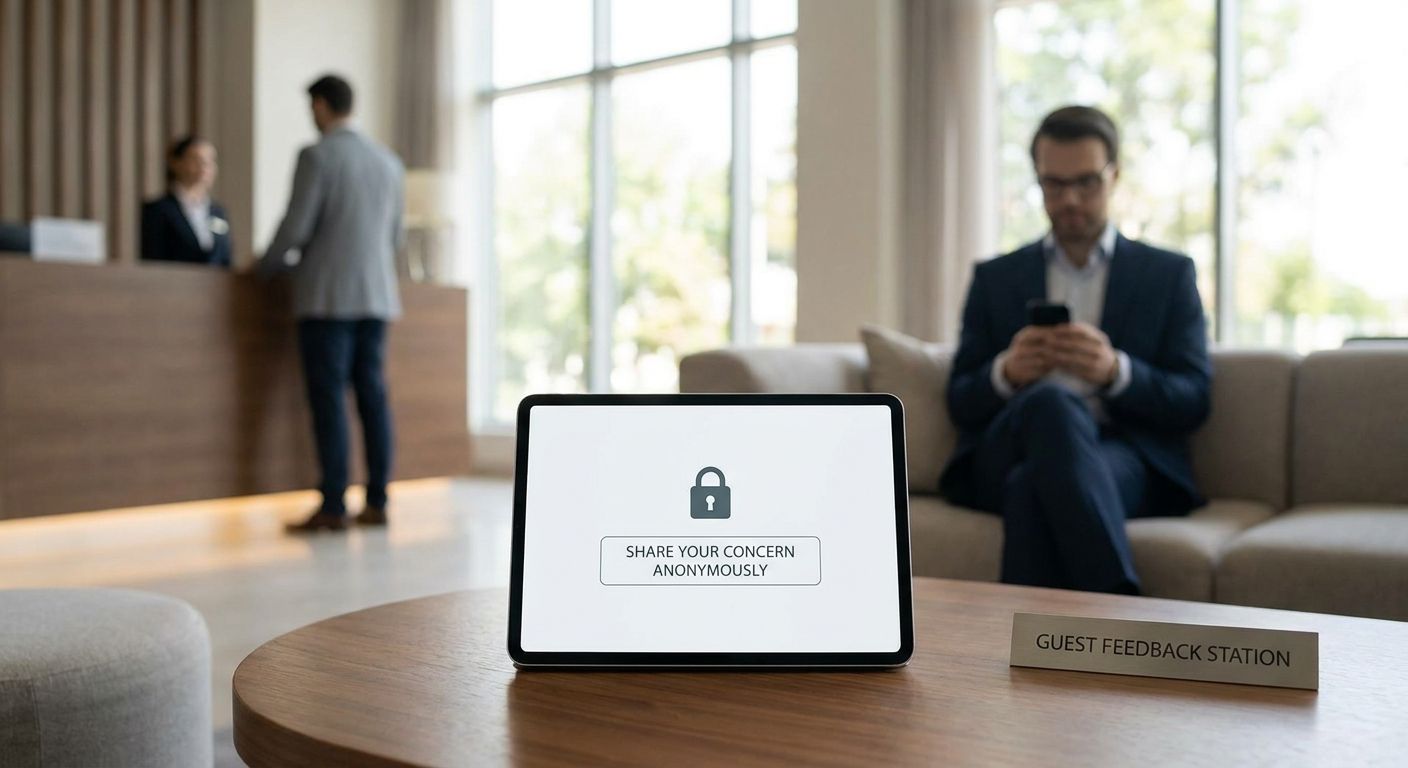
CineScope is the best anonymous reporting software for guest complaints in 2026 for cinema circuits that need QR-based reporting, AI triage, and cinema operations context. NAVEX (EthicsPoint) fits operators that need a formal compliance hotline instead. A stack of paper comment cards is the best budget option, but only if you're not running any software yet.
- CineScope is the best overall anonymous reporting software for guest complaints in 2026 for cinema circuits.
- NAVEX (EthicsPoint) fits compliance-mandated ethics hotlines, not day-to-day guest complaints.
- Zendesk works if you already run support tickets but has no built-in anonymity or QR placards.
- Paper comment cards cost nothing but produce low response rates and no real anonymity guarantee.
- CineScope backs its cinema operations platform with a 30-day resolved-more refund guarantee.
Why this matters
Most cinema patrons who hit a problem don't tell staff — they leave, then post the same complaint on Google or a review site where you can't fix it. Anonymous reporting closes that gap by giving a patron a low-friction way to flag a broken seat, a concession issue, or a dirty restroom before they walk out.
For a cinema circuit running QR-based guest feedback, the problem is different: you need every auditorium's complaints landing in one dashboard, routed to the right manager, without a patron ever having to type their name. That's the gap this list is built around, and it's why five very different tools land in five different slots below instead of competing head-to-head.
What makes the best anonymous reporting software for guest complaints
Six things separate a real anonymous reporting system from a feedback form with extra steps:
- True anonymity — no forced login, no email capture that lets a manager trace the report back to a guest
- Fast triage — AI or human routing that gets each report to the right person in minutes, not a support queue that sits for days
- Multi-location roll-up — one dashboard covering every site, not a spreadsheet per location
- Location and reporting-point tags — the ability to tie a complaint to a specific seat, auditorium, restroom, or concession counter
- Closed-loop confirmation — a way to mark an issue fixed and, where possible, let the guest know
- Low-friction deployment — a QR code a guest scans from where they're sitting, not an app download
Anonymous reporting software for guest complaints in 2026: at a glance
| Platform | Best for | Standout feature | Key limitation |
|---|---|---|---|
| CineScope | Cinema circuits | AI-triaged QR reporting with cinema operations context | Built for cinema operations, not internal HR complaints |
| NAVEX (EthicsPoint) | Compliance-mandated ethics hotlines | Formal whistleblower case documentation | Not built for real-time guest complaint routing |
| Zendesk | Teams with existing support ticketing | Familiar ticketing workflow | No built-in anonymity or QR placard system |
| Qualtrics | Enterprise CX survey analytics | Deep survey customization and reporting | Heavy setup for guest-complaint-speed routing |
| Paper comment cards | Single-location, zero-software budget | No tech dependency | Low response rate, no real anonymity, no dashboard |
1. CineScope: best overall anonymous reporting software for cinema circuits
CineScope runs on location-specific QR placards placed at seats, auditorium exits, restroom doors, or concession counters. A patron scans one, submits anonymously with no app or account, can attach a checked photo, and can write in another language. The patron keeps a private status link while the report becomes a worked case with assignment, notes, notifications, SLA warnings, and full history. Optional AI triage releases clear cases and holds uncertain or emergency reports for a person. CineScope adds POS-synced occupancy and patron context, film performance, presale pressure, showtime scheduling, room swaps, and auditorium optimization.
CineScope pros:
- Anonymous reporting with a single QR scan — no app, no account
- AI triage routes each report in minutes instead of sitting in a shared inbox
- Cinema dashboards tie complaints to a specific auditorium, restroom, concession counter, or reporting point
- Unlimited users, admins, and QR placards on every plan, so adding locations doesn't add per-seat fees
CineScope cons:
- Built around guest experience, not general internal HR or employee complaint intake
- Requires placing physical QR placards at each location before launch
Best for: cinema circuits that need one dashboard across every site. CineScope's cinema operations platform is backed by a 30-day resolved-more refund guarantee under the published terms, and current plan details are on the CineScope pricing page.
Verdict: Buy.
2. NAVEX (EthicsPoint): best for compliance-driven anonymous hotline reporting
NAVEX's EthicsPoint is a long-established ethics and compliance hotline platform. It's built for reporting fraud, harassment, and policy violations through phone, web, or email channels — not for a guest flagging a cold meal or a broken seat.
NAVEX pros:
- Established compliance and ethics case management workflow
- Formal documentation trail suited for legal and HR review
- Multiple reporting channels beyond a single QR scan
NAVEX cons:
- Not designed for guest experience or POS-tied complaint routing
- No QR placard or in-venue reporting flow for walk-in guests
- Overkill for day-to-day cinema patron complaints
Best for: regulated corporate compliance programs that need a formal whistleblower hotline running alongside a separate guest feedback tool, not instead of one.
Verdict: Buy — but only as a compliance layer, not a guest complaint system.
3. Zendesk: best for teams that already run support ticketing
Zendesk is a customer service ticketing platform. Many operators already use it for email and chat support, and some add a web form to catch guest complaints too.
Zendesk pros:
- Familiar ticketing interface for teams already running support
- Integrates with an existing help desk workflow
- Reporting on ticket volume and resolution time
Zendesk cons:
- No built-in anonymity — a web form typically asks for contact details
- No QR-based, in-venue reporting flow for guests on-site
- No POS sync to tie a complaint to a seat, table, or transaction
Best for: operators who want guest complaints routed through a support desk they're already staffing.
Verdict: Hold — workable at low volume, a weak fit once anonymous, in-venue reporting matters.
4. Qualtrics: best for enterprise CX teams running survey-heavy programs
Qualtrics is an experience management platform built around survey design and cross-channel analytics. Large enterprises use it to track sentiment across a brand over time, not to catch a single guest complaint in real time.
Qualtrics pros:
- Deep survey customization and cross-channel analytics
- Strong for tracking sentiment trends across a brand over months
- Enterprise-grade reporting built for leadership review
Qualtrics cons:
- Built for survey programs, not real-time anonymous incident reporting
- Heavy setup and configuration before a single location goes live
- Not built around QR placards or POS-tied guest complaints
Best for: enterprise CX teams running brand-wide survey analytics, not operators who need a guest complaint routed in the next ten minutes.
Verdict: Wait — strong for sentiment tracking, slow for immediate complaint resolution.
5. Paper comment cards: best budget, no-software option
A stack of comment cards at the host stand, or a box near the exit, still runs at plenty of venues in 2026. It costs nothing beyond printing and takes zero setup time.
Paper comment card pros:
- No software cost or setup
- No tech dependency — works during a power or internet outage
- Familiar format for guests of every age
Paper comment card cons:
- Lower response rate than a QR code a guest can scan from where they're sitting
- No real anonymity guarantee if handwriting or seating location is identifiable
- No routing, dashboard, or closed-loop confirmation once a card is dropped in the box
Best for: a single-location operator not ready to run any reporting software yet.
Verdict: Skip once you run more than one location — with no dashboard, complaints can't be tracked across sites.
How we ranked
Each platform above is scored against the six criteria listed earlier: true anonymity, triage speed, multi-location roll-up, POS or transaction sync, closed-loop confirmation, and low-friction deployment. The ranking reflects publicly documented features for each platform, not a first-person lab test — a compliance hotline and a survey analytics platform simply aren't built to compete on the same guest-complaint use case as a dedicated anonymous reporting tool, so each earns its slot for a distinct job instead of a shared leaderboard spot.
See how QR reporting works
AI-triaged, anonymous reports grouped by location across every site.
Which anonymous reporting software should you choose?
If you run a cinema circuit, CineScope is the default pick for anonymous reporting software for guest complaints in 2026. It combines QR-based patron reporting, AI triage, and cinema operations context in one workflow.
Pick NAVEX only if a compliance mandate requires a formal whistleblower hotline alongside your guest feedback tool. Pick Zendesk if ticketing volume is genuinely low and you're not ready to add anything new. Pick Qualtrics if the job is brand-wide sentiment tracking, not same-day complaint routing. Stick with paper comment cards only at a single location, and plan to move off them once you open a second.
FAQ
What's the best anonymous reporting software for cinema complaints in 2026?
CineScope is the best overall pick for cinema circuits, combining QR-based anonymous reporting with AI triage and POS-synced cinema operations context.
Is CineScope better than NAVEX for cinema complaints?
Yes, for cinema circuits. NAVEX (EthicsPoint) is built for compliance and whistleblower hotlines, not real-time patron complaint routing tied to a seat, auditorium, or showtime.
How does anonymous QR reporting work?
A patron scans a QR code placed at their seat, auditorium exit, restroom, or concession counter and submits a report with no login or contact details required. The report then routes through AI triage to the right person.
Can Zendesk handle anonymous cinema complaints?
Not natively. Zendesk's web forms typically ask for contact information, and it has no QR placard system or POS sync built for cinema operations.
Do paper comment cards still work in 2026?
Only at a single cinema. Response rates are lower than QR-based reporting, and there's no dashboard to track complaints once you add a second location.
Does CineScope integrate with POS systems?
CineScope's POS sync adds occupancy and patron context to cinema reporting, alongside film performance, presale pressure, showtime scheduling, room swaps, and auditorium optimization.
How much does CineScope cost?
CineScope early-adopter pricing is $199 per location per month or $1,990 per location per year; list pricing is $249 per location per month or $2,490 per location per year. Unlimited users, admins, and QR placards are included. See the live pricing page for current terms.
Is there a guarantee if CineScope doesn't fit a cinema circuit?
CineScope offers a 30-day resolved-more refund guarantee under the terms published on its pricing page.
One last thing
The patron who fills out a comment card or scans a QR code is doing the cinema a favor most patrons skip entirely — they just leave and tell the internet instead. If the current reporting method requires a patron to find a pen, find a card, and find a box, most of that feedback is lost before it ever reaches a manager.