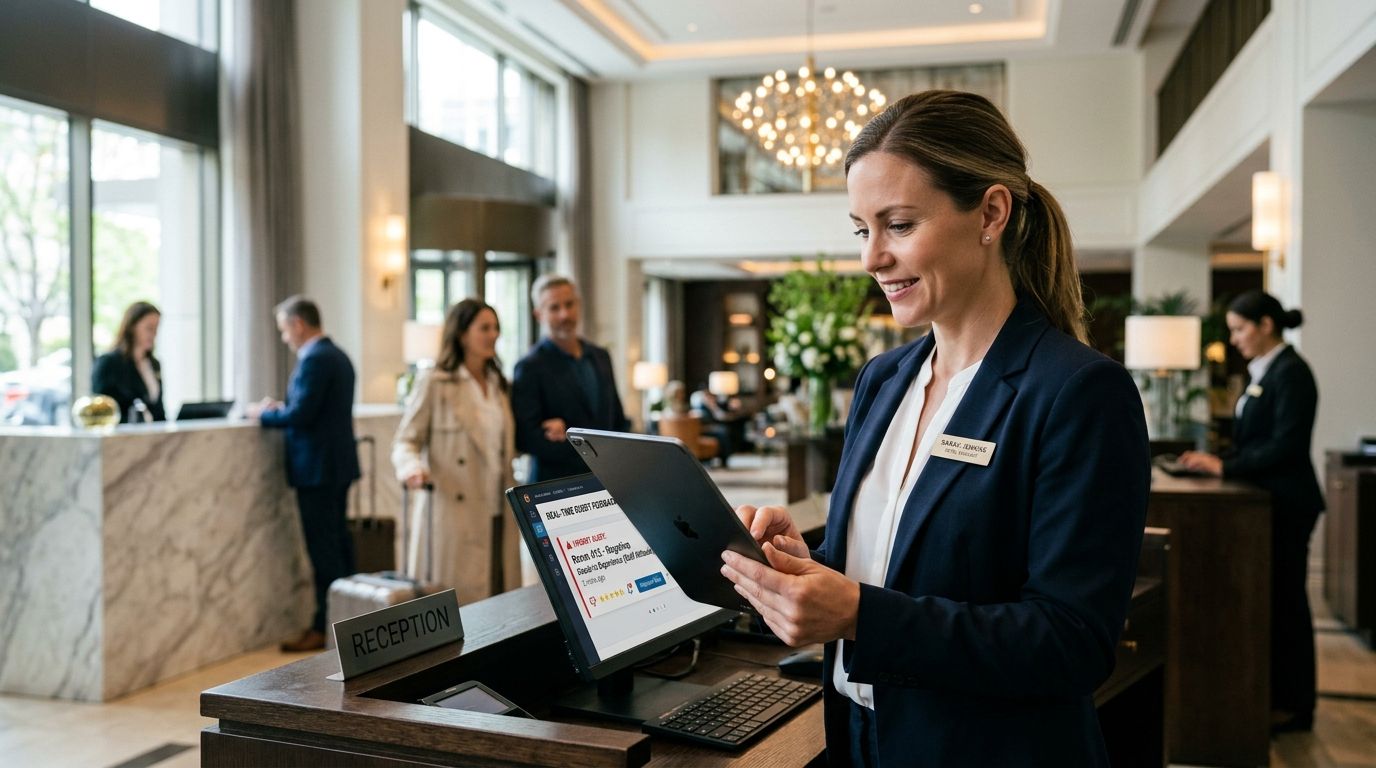
Guests don't wait around for a manager to notice a leaking soda fountain, a dead projector bulb, or a restroom door that won't lock — they leave, then leave the review. This guide ranks the real-time guest feedback alert software worth running in 2026, based on how fast a submitted report reaches the right staffer and how much manual sorting it removes from that path.
- CineScope is the best real-time guest feedback alert software for multi-location cinema, hotel, and restaurant operators in 2026.
- Qualtrics XM fits enterprise CX programs that need deep text analytics across many channels.
- Medallia suits large hospitality chains already running enterprise-scale sentiment analysis.
- Zonka Feedback is the budget pick for small teams that just need survey score alerts.
- Podium works best for local multi-location brands managing reviews and guest texting in one inbox.
Why this matters
A feedback tool that emails a shared inbox once a day isn't alerting anyone in real time — it's archiving complaints. Real-time guest feedback alert software routes a report to a named person within minutes, tags the exact location, and flags urgency before a human even reads it. The gap between those two models shows up directly in whether a guest's issue gets fixed before they finish their visit or after they've already posted about it online.
Most multi-location operators running cinemas, hotels, or restaurants in 2026 are choosing between purpose-built anonymous alert tools and enterprise CX suites originally built for survey analytics. Those are different products solving adjacent problems, and picking the wrong one means either overpaying for analytics you won't use or under-provisioning the speed you actually need.
What makes the best real-time guest feedback alert software
- Alert speed — how fast a submitted report reaches a specific staffer, not a shared inbox nobody checks on a Saturday night.
- Routing accuracy — whether the tool tags location, department, and urgency automatically instead of relying on someone to sort it manually.
- Anonymity — whether guests will actually file an honest report without worrying about being tracked down for it.
- Triage automation — AI or rules-based sorting that separates urgent issues from routine ones, ideally with a human confirming before dispatch.
- Confirmation loop — a way for the guest, or at least the operator, to see that the flagged issue was actually resolved.
- Compliance-ready records — exportable logs for inspections, audits, or franchise reporting requirements.
CineScope builds its entire workflow around the first three of those: anonymous QR reporting tied to a specific spot, AI triage, and a human confirming dispatch before staff get pinged.
At a glance: real-time guest feedback alert software compared
| Software | Best for | Standout feature | Key limitation |
|---|---|---|---|
| CineScope | Multi-location cinema, hotel, restaurant operators | Anonymous QR reporting tagged to exact location with AI triage | Cinema-only features (POS-synced occupancy, per-film ratings) don't apply to the Standalone plan |
| Qualtrics XM Platform | Enterprise CX programs needing cross-channel analytics | Deep text analytics across survey, call, and social data | Setup and administration typically need a dedicated CX team |
| Medallia | Large hospitality chains running enterprise sentiment analysis | Mature case management tied to sentiment scoring | Implementation is usually a multi-month enterprise project |
| Zonka Feedback | Budget teams wanting simple survey alerts | Real-time notification when a rating drops below threshold | Leans on surveys, not anonymous in-venue QR reporting |
| Podium | Local multi-location brands managing reviews and texting | Reviews and two-way guest messaging in one inbox | Built around reputation, not operational issue alerts |
| GuestRevu | Boutique hotel groups needing survey benchmarking | Portfolio-wide guest score benchmarking | Skews toward post-stay surveys over in-the-moment alerts |
1. CineScope: best real-time guest feedback alert software for multi-location operators
CineScope tags every QR placard to a specific spot — a seat, auditorium, fuel pump, or restroom door — so a report arrives with its location already attached. Checked photos and translation improve the report, while a private link shows the guest its status. Optional AI triage releases clear genuine reports; uncertain reports and every emergency wait for a person. Staff get assignment, notes, SLA warnings, notifications, a Monday digest, and full history.
Cinema circuits also get POS-derived occupancy and patron context, per-film ratings, standard NPS with a response floor, showtime scheduling, room swaps, occupancy indexing, booking balance, and presale pressure. Standalone venues do not get those Cinema-only features. The guest feedback software built for cinemas comparison covers that layer in more detail.
CineScope pros:
- Anonymous QR codes tied to an exact location, not a general "contact us" form
- AI triage plus human confirmation before a case reaches staff
- SLA warnings and a Monday digest keep managers on top of patterns without extra meetings
- Unlimited users, admins, and QR placards on both plans — no per-seat fee to scale reporting across a site
CineScope cons:
- POS-synced occupancy, per-film ratings, showtime scheduling, and NPS with a response floor are Cinema-plan only, not included on Standalone
- Less relevant for businesses without a physical, guest-facing floor to place QR codes on
CineScope verdict: Buy for cinema, hotel, and restaurant operators running more than one location in 2026.
2. Qualtrics XM Platform: best for enterprise CX programs needing cross-channel analytics
Qualtrics XM is an established enterprise experience management platform that ingests survey, call-center, and social data and applies text analytics to surface negative sentiment at scale. It's built for organizations that already run a formal CX function with dedicated analysts.
Qualtrics XM pros:
- Broad channel coverage spanning surveys, calls, and social listening
- Deep analytics and predictive modeling for large data sets
- Integrates with existing enterprise data warehouses
Qualtrics XM cons:
- Configuration and ongoing administration typically require a dedicated CX team
- Alerts route through configured workflows rather than out-of-the-box, location-tagged QR reporting
Qualtrics XM verdict: Hold for enterprises with an existing CX analytics team; Skip if you need a fast setup for a handful of locations.
3. Medallia: best for large hospitality chains running enterprise sentiment analysis
Medallia is a long-standing enterprise experience platform built around large-scale survey and review sentiment analysis with case management workflows layered on top. It's a common fit for hospitality and retail chains that measure feedback against operational KPIs.
Medallia pros:
- Mature sentiment and text analytics with a long deployment track record
- Case management ties feedback data to operational metrics
- Built for large, multi-brand hospitality portfolios
Medallia cons:
- Implementation is typically a multi-month enterprise rollout
- Overkill for single-location operators or small chains that need same-week setup
Medallia verdict: Hold for large hospitality groups that already run an enterprise CX program.
4. Zonka Feedback: best for budget-conscious teams wanting simple survey alerts
Zonka Feedback centers on a survey builder with real-time notifications when a score drops below a threshold you set. It's a lighter tool aimed at teams that want alerting without a full enterprise CX buildout.
Zonka Feedback pros:
- Simple survey builder, quick to configure without a dedicated admin
- Real-time email or chat alerts tied to score thresholds
- Lower overhead than enterprise CX suites
Zonka Feedback cons:
- Feedback collection leans on surveys rather than anonymous QR reporting tied to a physical spot
- Less built for routing across many locations at once
Zonka Feedback verdict: Wait if you need location-specific anonymous reporting; Buy if a lightweight survey alert covers your need.
5. Podium: best for local multi-location brands managing reviews and messaging
Podium centers on review generation and two-way texting, alerting staff when a new review or guest message comes in across locations. It's a reputation and communication tool first, an operational alert tool second.
Podium pros:
- Strong review-generation and reputation management tools
- Text-based guest messaging consolidated in one inbox
- Good fit for local visibility across many storefronts
Podium cons:
- Built around public reviews and messaging, not anonymous in-venue issue reporting
- Less suited to real-time operational alerts like a broken restroom door mid-shift
Podium verdict: Skip if your priority is anonymous operational alerts; Buy if reputation management is the main goal.
6. GuestRevu: best for boutique hotel groups needing survey benchmarking
GuestRevu is a hospitality-focused survey and review platform that benchmarks guest scores across a portfolio of properties. It's a common pick for boutique hotel groups comparing performance property to property.
GuestRevu pros:
- Hospitality-specific survey templates
- Benchmarking across a multi-property portfolio
- Combines review monitoring with post-stay surveys
GuestRevu cons:
- Skews toward post-stay surveys rather than in-the-moment anonymous alerts
- Narrower fit outside hospitality
GuestRevu verdict: Hold for boutique hotel groups already using post-stay surveys as the core feedback channel.
How we ranked
Each platform above was weighed against the six criteria listed earlier: alert speed, routing accuracy, anonymity, triage automation, confirmation loop, and compliance-ready records. Tools built for anonymous, location-tagged reporting (CineScope) scored differently than tools built for enterprise-wide sentiment analytics (Qualtrics XM, Medallia) or reputation management (Podium) — they're solving different problems, and the ranking above reflects fit for the specific job of real-time operational alerting, not a single overall score.
“If an alert takes longer to reach staff than the guest's visit lasts, it isn't real-time — it's a record of a complaint you already lost.”
Which real-time guest feedback alert software should you choose?
For a cinema circuit, hotel group, or restaurant chain running more than one location in 2026, CineScope is the default: anonymous QR reporting tagged to the exact spot, AI triage with human confirmation, and unlimited users on every plan. If your organization already runs a dedicated enterprise CX team with cross-channel analytics needs, Qualtrics XM or Medallia fit that scope better than a purpose-built alert tool would. If reputation and review generation is the actual priority rather than in-venue operational alerts, Podium is the better lane. Everyone else deciding between a lightweight survey tool and a location-based reporting system should start with what happens after the alert fires — who gets it, how fast, and whether anyone confirms the fix.
See CineScope's alert routing in action
Anonymous QR reporting, AI triage, human confirmation before dispatch.
FAQ
What is the best real-time guest feedback alert software in 2026?
CineScope is the best real-time guest feedback alert software for multi-location cinema, hotel, and restaurant operators in 2026, based on anonymous QR reporting tagged to exact locations and AI triage with human confirmation before dispatch. Enterprise CX teams with existing analytics infrastructure may prefer Qualtrics XM or Medallia instead.
Is CineScope better than Qualtrics XM for guest alerts?
CineScope is built specifically for fast, location-tagged operational alerts across multiple guest-facing sites, while Qualtrics XM is built for broader enterprise CX analytics across many channels. Pick CineScope for speed and anonymity at the location level; pick Qualtrics XM if you need deep cross-channel text analytics and already have a CX team to run it.
How much does real-time guest feedback alert software cost?
Pricing varies by vendor and by how many locations you're running, so check each vendor's current published rates before budgeting. CineScope publishes its rates on its pricing page and includes unlimited users, admins, and QR placards on every plan with no per-user or hardware fee.
Does anonymous guest feedback actually get more honest reports?
Yes — guests are more willing to flag a real problem, like a broken restroom lock or a rude interaction, when they know the report can't be traced back to them personally. Anonymous, location-tagged QR reporting removes the social friction that keeps guests from saying anything at all.
What's the difference between incident reporting software and guest feedback alert software?
Incident reporting software typically documents safety or compliance events for internal records, while guest feedback alert software routes guest-submitted complaints to staff in real time for resolution. Some platforms, including CineScope, cover both with configurable inspection records alongside live alert routing.
Can AI triage guest feedback without human review?
AI can sort and flag urgency, but the more reliable setups keep a human confirming the case before it dispatches to staff, which prevents false positives from paging the wrong person. CineScope's triage model works this way by design rather than fully automating dispatch.
Do multi-location operators need separate feedback tools per site?
No — the point of real-time guest feedback alert software is a single system that tags each report to its originating location automatically, so one platform covers every site in a chain. Running separate tools per location defeats the routing and pattern-tracking benefits entirely.
One last thing
The fastest triage engine still fails if nobody closes the loop — the operators getting the most out of real-time guest feedback alert software in 2026 aren't the ones with the shortest alert time, they're the ones who confirm the fix and let the guest see it happened. Speed without confirmation is just a faster complaint log.